
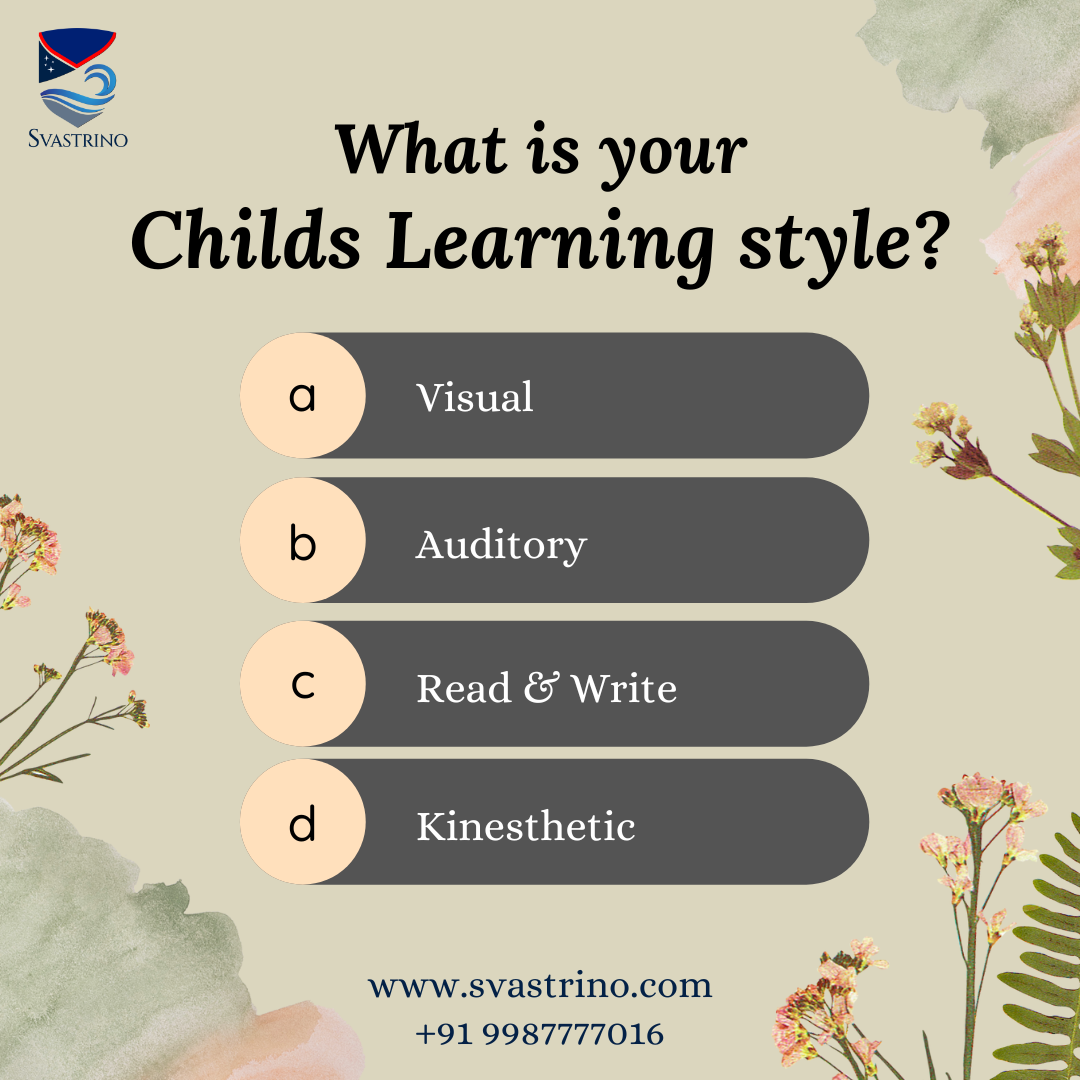
Have you ever thought about why some childs do well in school while others don’t, even when they try hard? It’s like the story of Albert Einstein – yes, the famous scientist! He didn’t do great in regular school. This tells us something important: childs don’t all learn the same way. Just like each child has their favorite food or game, they also have their special way of learning. In this blog, we’re going to talk about these different ways of learning, which are called Visual, Auditory, and Kinesthetic. We’ll give you some easy tips to figure out how your child likes to learn and show you ways to help them do better in school. Imagine helping your child learn in a way that’s just right for them – it would help them shine, just like Einstein!
What Are Learning Styles?
Have you ever noticed how every one of us learns things uniquely in our own way? While some of us need to be hands-on, others would rather listen, whereas others need to see visuals. We refer to this as “learning styles.” It’s similar to how every one of us has an ice cream flavor preference; everyone is unique, and that’s good! The strategies that each of us finds most effective while learning something new are known as our learning styles. Visual, auditory, and kinesthetic are the three primary categories. Learning can be much more efficient and enjoyable if these are understood.
- Visual Learning Style: Visual learners are like detectives who love clues in the form of images. They understand and remember things better when they see them in pictures, charts, or diagrams.
- Auditory Learning Style: Auditory learners are all about listening. They soak up information like sponges when they hear it, whether it’s a teacher talking, an audio recording, or even a song.
- Kinesthetic Learning Style: Kinesthetic learners are the movers and shakers. They need to physically engage with things to learn best, like through experiments, hands-on activities, or even acting out a scene
- Read & Write Learning Style: Read & write learners are like bookworms who love diving into the written word. They thrive on reading texts and writing notes. They find joy in lists, written explanations, and essays. For them, the magic happens when they jot down information or immerse themselves in a book.
Understanding these learning styles isn’t just good for students; it’s a game-changer for teachers and parents too. By knowing whether a child is a visual, auditory, or kinesthetic learner, we can help them learn in the way that suits them best.
1. Strategies for Visual Learners
Visual learners are like little artists at heart – they grasp things better when they’re shown a picture or a design. If your child or student learns best this way, here are some fun and effective strategies to help them shine:
Bring on the Imagery:
Picture-Perfect Learning: Use lots of images in their study materials. Whether it’s textbooks with plenty of pictures, educational videos, or colorful infographics, these tools can make learning more engaging for them.
Why It Works: Visual learners process information better when it’s in a format they can see and visually interact with. It’s like turning a lesson into a visual story they can follow.
Color Coding is Key:
Try This: Encourage them to use different colors for different subjects or topics in their notes. For example, use blue for math formulas and green for science facts.
The Benefit: Colors can help organize information and make it easier to remember. It’s like having a color-coded map in their brain!
Visualization Techniques:
Mind’s Eye: Show students how to generate mental representations of what they’re learning. For example, if they are studying a historical event, they may visualize the situation in their minds.
The Power of Imagination: This strategy helps students improve their knowledge and recall by using their inherent inclination for visual thinking.
Using Diagrams and Charts:
Graphical Guides: Diagrams, flowcharts, and other visual organizers can be incredibly helpful. They can use these to break down complex information into simpler, more digestible visual formats.
Seeing the Big Picture: These tools help in organizing thoughts and information visually, making it easier for visual learners to grasp and remember the material.
By incorporating these strategies, you’re not just teaching visual learners; you’re tuning into their world of colorful and imaginative learning. It’s like giving them a paintbrush and a palette to color their knowledge in a way that makes sense to them. This approach can make learning a more enjoyable and fruitful journey for those who think in pictures and visuals.
2. Strategies for Auditory Learners
Auditory learners are like little sponges when it comes to sounds and words – they absorb information best through their ears. If you’re guiding an auditory learner, here are some engaging and practical strategies to enhance their learning experience:
Encourage Active Participation in Discussions:
Talk It Out: Get them involved in group discussions or study groups. It’s like having a conversation where they can bounce ideas off others and learn through dialogue.
The Benefit: This interactive approach helps them process and remember information better as they hear different perspectives and explanations.
Utilize Mnemonic Devices:
Memory Tricks: Teach them to use rhymes, songs, or acronyms to remember information. It’s like creating catchy jingles that stick in their mind.
Why It Works: These tools play to their auditory strengths, making it easier for them to recall facts and details later.
Incorporate Audio Recordings:
Listen and Learn: Encourage them to listen to recordings of lectures, audiobooks, or educational podcasts. They can even record your explanations or their own summaries.
The Audio Advantage: This method allows them to revisit and reinforce learning materials just by listening, which is perfect for their auditory nature.
Practice Reading Aloud:
Hear the Words: Have them read their notes or textbooks out loud. It’s like they’re giving a mini-lecture to themselves.
The Power of Hearing: Reading aloud helps them process information through their preferred auditory channel, enhancing understanding and retention.
Use Repetition as a Learning Tool:
Repeat for Retention: Encourage them to repeat information or instructions back to you. It’s a bit like rehearsing lines for a play.
Why Repeating Helps: This technique reinforces their learning by actively using their auditory skills.
By adopting these strategies, you’re essentially tuning into the world of auditory learners, where hearing is the key to learning. It’s like setting the stage for them to listen, process, and absorb information in a way that naturally resonates with them. This approach not only makes learning more effective for auditory learners but also turns it into an enjoyable and engaging process.
3. Strategies for Kinesthetic Learners
Kinesthetic learners are the movers and shakers in the world of education. They grasp things best when they’re actively involved in the learning process. If you’re helping a kinesthetic learner, here are some dynamic and fun strategies to support their unique learning style:
Hands-On Activities Are Key:
Learning by Doing: Encourage activities where they can use their hands, like building models, conducting science experiments, or creating art projects. It’s like learning through a series of mini-adventures.
The Active Advantage: These activities align with their need to touch and manipulate objects, helping them understand and remember concepts more effectively.
Incorporate Movement into Learning:
Move to Learn: Let them move around while they study. This could be as simple as walking while reading or jumping between points written on the floor.
Why Movement Matters: Movement helps kinesthetic learners focus and process information, turning a static activity into an active learning experience.
Use Role-Playing to Reinforce Concepts:
Act It Out: Role-playing historical events or scientific concepts can be a great way to learn. It’s like they’re stepping into a story and living it.
The Role-Play Benefit: This method helps them internalize information by experiencing it, making learning more memorable and engaging.
Physical Exercises to Enhance Memory:
Exercise While Learning: Simple physical exercises, like stretching or balancing, can be paired with learning tasks. For instance, reciting multiplication tables while doing a balancing exercise.
Exercise and Memory: Physical activity can boost brain function, making it easier for kinesthetic learners to absorb and retain information.
By implementing these strategies, you are not only teaching kinesthetic learners but also engaging them in a way that meets their natural urge to move and engage. It’s like providing children a playground where every action provides an opportunity to learn and grow
4. Strategies for reading and writing learners
For learners who thrive on reading and writing, the traditional approach of textbooks and note-taking is just the tip of the iceberg. Here are some strategies to enhance their learning experience, turning words into a powerful tool for understanding and retention
Write It Down:
Note-Taking Mastery: Encourage them to write down key points during lessons or while reading. This could be in the form of bullet points, summaries, or even their own words.
Why It Works: Writing helps solidify information in their memory. It’s like making a personal handbook on what they’re learning.
Reading as a Tool:
Engaging with Texts: Provide plenty of reading materials related to the subject. This could include books, articles, and study guides.
The Benefit: Reading extensively on a subject helps deepen understanding and retention. It’s like piecing together a puzzle where each piece is a new fact or idea.
Flashcards for Review:
Quick Recall: Use flashcards for important terms, dates, or concepts. They can write a question on one side and the answer on the other.
The Power of Repetition: Regularly reviewing flashcards can improve memory and recall. It’s a bit like training your brain to quickly access information.
Structured Outlines:
Organized Thoughts: Show them how to create outlines for essays or projects. This can start with broad topics and narrow down to specific details.
Clarity and Cohesion: Outlines help in organizing thoughts in a logical order, making writing tasks less daunting and more coherent.
Incorporating these strategies can greatly benefit readers and writers by leveraging their strengths in engaging with text and expressing their understanding through writing. It’s like giving them a toolbox where each tool is a different way to interact with and master the material.
5. Balancing Different Learning Styles
It’s quite common to find that many child’s don’t fit perfectly into just one learning style box. Instead, they might show a blend of visual, auditory, and kinesthetic preferences. This mix is like having a palette of different colors to paint with – each one adds something special to the overall picture. Here is guidance on how to properly cater to these diverse learning preferences.
Combine Learning Methods:
Mix and Match: Use a combination of visual aids, auditory exercises, and hands-on activities. For example, while teaching a science concept, you could start with an explanatory video (visual), follow it with a discussion (auditory), and end with an experiment (kinesthetic).
The Benefit: This approach keeps learning fresh and engaging, catering to different aspects of their learning personality.
Observe and Adapt:
Tailor as You Go: Pay attention to how your child responds to different teaching methods. You might notice they prefer visual aids for some subjects but enjoy hands-on activities for others.
Why It’s Effective: Adapting to their responses ensures that they’re always learning in a way that works best for them, making the process more efficient and enjoyable.
Encourage Flexibility in Learning:
Versatile Learning: Teach your child to be flexible and open to different ways of learning. It’s like having multiple tools in their toolbox, ready for any task.
The Advantage: Being adaptable in their learning approach prepares them for diverse learning environments and challenges.
By using a variety of teaching methods, you’re making sure that learning is always fresh and exciting for them. It’s like giving them a buffet of learning options, and they can choose what they like best each day. This way, you’re not just sticking to one way of teaching, but you’re adapting to how they learn best at different times. It makes learning fun and effective, and your child gets to explore and grow in the way that’s just right for them.
In this exploration of learning styles, we’ve uncovered the unique ways in which each child absorbs and interacts with knowledge. Whether they are visual, auditory, kinesthetic learners, Read & Write Learners or a blend of these, it’s clear that there is no one-size-fits-all approach to education. By recognizing and embracing these differences, we open the door to more effective, engaging, and enjoyable learning experiences for every child.
At Svastrino, we understand the importance of this diversity in learning. Our Breakthrough Program is specifically designed to cater to these varied learning styles. We believe that by providing personalized and adaptable learning strategies, we can unlock each child’s full potential, much like fitting a key perfectly into a lock. Our program is not just about academic achievement; it’s about nurturing a lifelong love for learning and equipping young minds with the skills to thrive in an ever-changing world.
By choosing Svastrino’s Breakthrough Program, you’re choosing to step away from the traditional, rigid methods of education. Instead, you’re stepping into a world where education is a dynamic, interactive, and personalized journey. Here, every child is given the tools and opportunities to shine in their own unique way, preparing them not just for school, but for life. Join us in redefining education, and watch as your child embarks on a path of discovery, growth, and success.